
A client bought a short-term rental for $527,725. On a normal depreciation schedule, that property produced $10,710 of deductions a year.
After a cost segregation study, the first-year deduction was $147,168. In the 35% bracket, that is $51,508 of tax deferred on a single property.
That is what cost segregation does. It takes a building that would otherwise depreciate over 27.5 or 39 years as one line item and breaks it into its components, so the parts with shorter real lives get shorter tax lives. Carpet, cabinets, appliances, fencing, and landscaping stop waiting three decades to be written off.
The strategy is real and the numbers are large. It is also not automatic.
Three things have to be true before a study earns what it costs. The property needs enough depreciable basis once the land comes out, and in some markets land is 80% of the value. You need to be in a bracket high enough that the deduction is worth taking, because a deduction is only ever worth a percentage of itself. And you need a way to actually use the loss, because rental losses are passive by default, and a suspended loss does nothing for you this year.
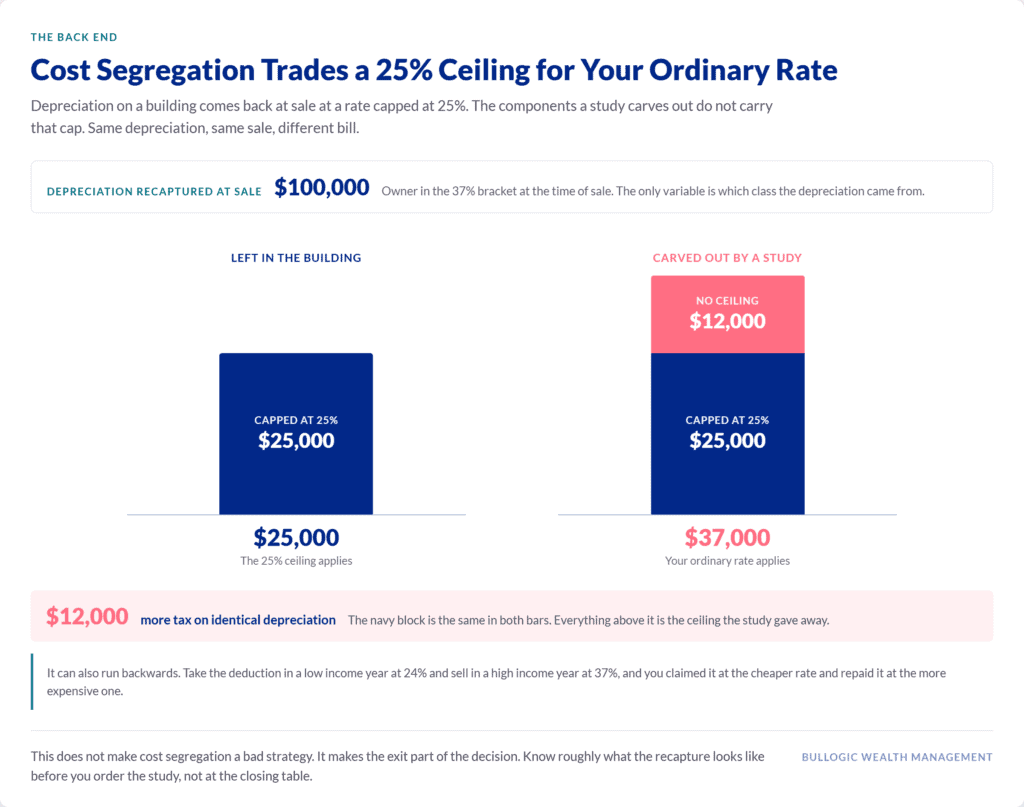
One more thing is worth understanding before you order a study rather than after. Depreciation on a building comes back at sale at a rate capped at 25%. The components a cost segregation study carves out do not carry that cap. They come back at your ordinary rate. Cost segregation moves the deduction forward, and it also changes what it costs you to pay back.
This post covers what a study costs, what it saves using real numbers from a real study, who qualifies, the three ways to unlock the loss, when the answer is no, and how to tell a defensible study from a cheap one.
What is a cost segregation study?
What is a cost segregation study?
A cost segregation study is an engineering analysis that separates a building into its components and assigns each one a depreciation life. Instead of writing the whole property off over 27.5 or 39 years, items like carpet, cabinets, fencing, and landscaping get 5, 7, or 15-year lives and deduct much faster.
A cost segregation is an analysis that takes a building and breaks it into multiple components.
A cost segregation study is performed for one reason: depreciation.
Normally a property taken for depreciation is listed as a single line item on the tax return. It may be broken into two items if the tax preparer broke out the land value and placed it on the return too.
A residential rental property depreciates over 27.5 years. A commercial property depreciates over 39 years. This includes properties rented to third parties, and properties rented to your own business.
These are incredibly slow depreciation schedules.
While the property itself may have a long shelf life, not everything inside the building lasts 27.5 or 39 years.
What if there was a way to cut a property into the shell of the building and then all of the components inside? The shell stays at 27.5 or 39 years, but items like appliances, fences, carpet, flooring, cabinets, and landscaping get more realistic life spans.
That is what a cost segregation study does. An engineering firm, not a tax preparer, sends engineers into the building and values all the assets inside separately. Those individual assets get their true depreciable life as 5, 7, and 15-year property.
Now instead of your depreciation schedule showing one item, maybe two, it shows 200 to 300 of them. And any 5, 7, and 15-year property qualifies for accelerated depreciation, thanks to our current 100% bonus depreciation.
Here is the study behind the numbers at the top of this post.
| Total cost of short-term rental | $527,725 |
| Less land value | ($110,000) |
| Depreciable basis | $417,725 |
Normally, since this is a short-term rental, it depreciates over 39 years, which makes the annual depreciation $10,710.
The study carved the assets into the following groups:
| Class | Amount |
|---|---|
| 39-year property | $277,674 |
| 15-year property | $50,002 |
| 5-year property | $90,047 |
With bonus depreciation, they deducted $147,168 in the first year. That is $277,674 ÷ 39 years, plus $50,002, plus $90,047.
Now instead of $10,710 of ongoing annual deduction, it is $7,119. Everything except the shell has already been written off.
For a client in the 35% tax bracket, that first-year deduction is worth $51,508 of deferred tax.

How much does a cost segregation study cost?
How much does a cost segregation study cost?
Most engineered studies run $3,000 to $15,000 depending on property size, type, and complexity. A small residential rental sits at the low end and a large commercial property at the high end. Questionnaire-based studies cost less, often under $1,000, but they carry weaker audit support.
For what they deliver, cost segregation studies are very affordable. You have a range of different providers that can perform the analysis.
Your first set of providers are virtual firms. These are firms that use AI or other means to develop the asset breakdown. They typically work from questionnaires, photographs, and other virtual means to give you a report. These land on the cheaper end, think $1,000 for a full analysis.
We would not recommend these types of studies. You are using a cost segregation analysis to get a large tax deduction. It is all legal, but any time you are taking a large tax deduction, you want the analysis to be defensible. We cover what separates a defensible study from a cheap one further down.
The next step up are providers that send engineers to the location to do the analysis. These firms are the way to go for your studies. These studies run between $3,000 and $15,000. The rate depends on the firm, but mainly on the type of property. A small residential property sits on the lower side and a large commercial facility on the higher side.
One cost people miss is the return itself. A cost segregation study hands your preparer a report with 200 to 300 assets on it, and those assets have to be entered and tracked on your depreciation schedule every year going forward. Expect your preparation fee to go up, often by around $2,000 in the first year. Budget for the study and the return together, not just the study.
What is an example of cost segregation?
What is an example of cost segregation?
On a $650,000 short-term rental with $520,000 of building basis, a study might reclassify roughly 25% into 5, 7, and 15-year property. With 100% bonus depreciation, that portion deducts in year one instead of spreading across 39 years, turning a modest annual deduction into a large one.
The study at the top of this post was a short-term rental on a 39-year schedule. Here is the same math on a long-term residential rental, which is the more common situation.
| Purchase price | $400,000 |
| Less land (25% per assessor ratio) | ($100,000) |
| Depreciable basis | $300,000 |
| Reclassified into 5 and 15-year property (20%) | $60,000 |
| Remaining shell (27.5 years) | $240,000 |
| Without a study | With a study | |
|---|---|---|
| Shell depreciation, year one | $10,909 | $8,727 |
| Bonus depreciation on reclassified property | $0 | $60,000 |
| Year one deduction | $10,909 | $68,727 |
That is $57,818 of additional deduction in the first year. For an owner in the 32% bracket, it is worth $18,502. Net of a $4,000 study and roughly $2,000 of additional return preparation, you are ahead about $12,500 in year one.
The 20% in that table is not a number the study hands you. It is a number you can estimate before you order one, and estimating it first is how you decide whether to bother.
First, start with the property. Commercial properties are usually good candidates, especially if it is your business using it.
For a residential property, look at the depreciable basis. You want to start with the purchase price of the property and then subtract out the land. In a lot of cases, we have seen land take up to 80% of the home’s value. Land cannot be depreciated, so a cost segregation study and bonus depreciation do nothing for you if most of the value is in the land. Start with your county property tax website to find the split of home (improvement) and land value.
Once you have your depreciable basis, you can set a rule of thumb for how much of it falls under 5, 7, and 15-year asset life. For a residential property you are looking at 20% to 30%. Obviously, this varies depending on what is inside the property, but it is a good place to start. Use the 20% conservative number to see how large the deduction gets.
For commercial properties, these are good rules of thumb:
- Apartments 20-35%
- Car dealerships 25-50%
- Golf courses 20-40%
- Grocery stores 20-30%
- Hotels and motels 20-30%
- Manufacturing and processing (heavy) 30-60%
- Manufacturing (light) 20-40%
- Medical office and medical arts buildings 20-40%
- Offices 20-40%
- Research and development 30-60%
- Restaurants 20-40%
- Retail 20-30%
- Senior and assisted living 15-25%
- Strip malls and regional malls 5-30%
- Tenant improvements 5-50%
- Theaters 20-40%
- Warehouses 5-10%
Not all deductions were created equal. Deductions, by their nature, depend on your tax bracket. A credit gives you a dollar-for-dollar reduction. A deduction gives you a percentage.
For example, your cost segregation study comes back with $100,000 in depreciation. In the 35% bracket, that is worth $35,000. In the 12% bracket, it is worth $12,000.
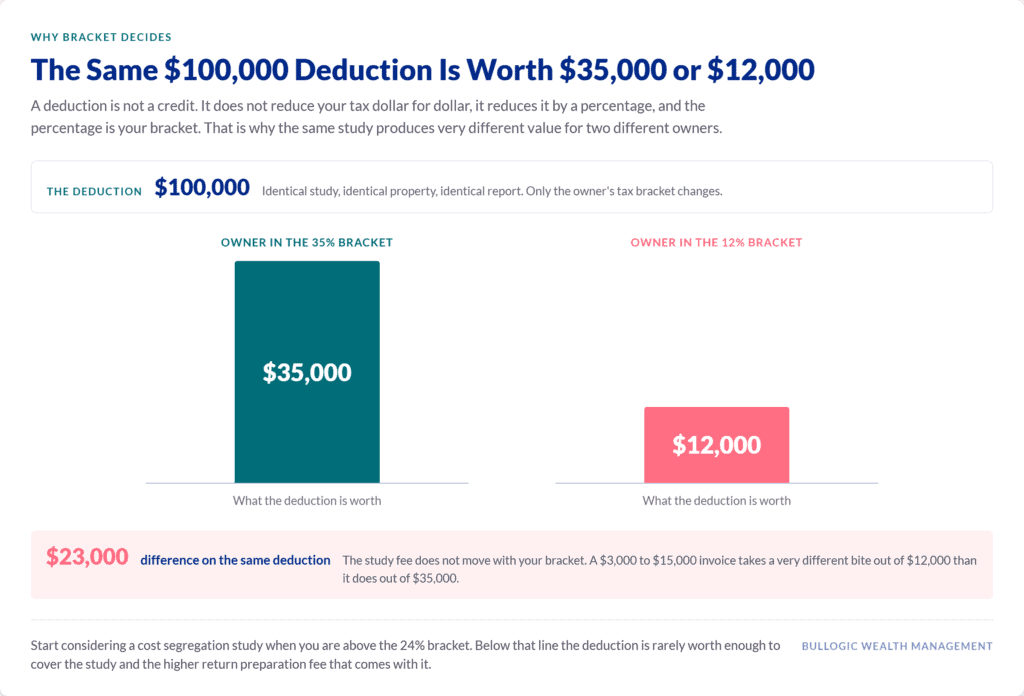
If the deduction is only worth $12,000 to you, is it worth paying $3,000 for the study, plus the increase in your preparation fee we covered above? That may still be worth it for you. Now you have a good idea of what to expect before going through this process.
Who is eligible for a cost segregation study?
Who is eligible for a cost segregation study?
Any owner of income-producing real property can order a study. That includes residential rentals, short-term rentals, commercial buildings, and properties held in an LLC or partnership. Your primary residence does not qualify because it produces no income. Land never qualifies because land is not depreciable.
If you have an income-producing property, you can order a cost segregation study.
It does not matter if the property is a long-term residential property, short-term rental, commercial building, or a commercial building used by your business. It can be held in an LLC, partnership, S-corp, or C-corp.
Your primary residence does not qualify because it does not produce income. You are not depreciating your primary residence on your tax return.
The edge cases are a home office or the portion of your home you rent out on Airbnb. Those portions do produce income and do get depreciated, so technically they are eligible. In practice the depreciable basis is small enough that a study never pays for itself. Skip it.
You can also order a study on a property you have owned for years, not just one you bought this year. That takes an extra step at filing, which we cover further down.
By running through the rules of thumb we listed out above, you can tell whether your property is worth the cost segregation study. High land ratios, low tax brackets, or low depreciable basis (under $200,000) are all good reasons not to do a cost segregation study.
The question that decides everything: can you actually use the loss?
Can you use the loss from a cost segregation study?
Only if the loss is not trapped by the passive activity rules. Rental losses are passive by default and can only offset passive income. To deduct against ordinary income you generally need real estate professional status, or a short-term rental where you materially participate. Without one of those, the deduction sits suspended.
When you start depreciating a rental property, unless you have run a cost segregation study, you are almost certainly depreciating the whole thing as a single line item. One building, one number, 27.5 years. Simple, and it Only if you can move the activity from passive to nonpassive. That is the question to answer before you order a study, not after.
Under §469, rental activity is passive. Passive losses can only offset other passive income. You need to either have a method for converting the passive activity to nonpassive or have a lot of passive income that needs to be absorbed.
If you do not have one of those two items, you create suspended passive losses that sit on your tax return not delivering a benefit. That means you spent roughly $4,000 on a cost segregation study and another $2,000 on the return, and received nothing this year for either. You have to wait until you sell the property to unlock all the suspended passive losses.
There are a few ways to move a rental activity from passive to nonpassive.
First, if your modified adjusted gross income is below $100,000, you can take up to $25,000 of the passive losses against your ordinary income. This route requires active participation, which is a lower bar than material participation and generally means you are the one making management decisions. The $25,000 allowance phases out between $100,000 and $150,000 of MAGI, so at $140,000 you are down to $5,000, and above $150,000 it is gone entirely. This is a tough test to meet, but for the right taxpayer it can be a great benefit. If you are retired, taking a sabbatical, or in a low-income couple of years, you can use a cost segregation study to get a large deduction and use the $25,000 limit to spread it out over the next few years while your income stays below the phase-out.
Real Estate Professional Status (REPS) is your second option. Qualifying for REPS can be difficult if you are not in real estate full time. You have two tests to meet:
- You spend over 750 hours a year in real estate activities that are serving your business of real estate. You do not have to be a licensed real estate broker or agent. Managing your portfolio or properties is enough as long as you are getting the hours. It is very important to keep a time log throughout the year to support the 750-hour test.
- The majority of your time needs to be spent on real estate. That means if you have a W2 job, you probably do not qualify for REPS. If that W2 job were to cease before mid-year, you can still qualify. Once you go beyond that halfway point, you cannot make a claim that more than half your time is spent in real estate, and you fail REPS. REPS works for short-term and long-term rental activities, so if you can qualify, it is powerful.
Material participation is the last option to move your passive rental activity to nonpassive. Material participation, in this instance, is focused on short-term rentals. The IRS gives us seven different tests we can meet for material participation. You only have to meet one of them. The typical test taxpayers meet is number three: working 100 hours in the property and more time than anyone else. You need to keep a time log of not only your own time working on the property but also anyone else who works on it. If you are not careful, the cleaning crew works more hours in the property than you do and you lose material participation.
The nice part about the second option (REPS) and the third (material participation) is that you only need to achieve it in the year the cost segregation is taken. If you meet material participation in your short-term rental because you worked all the hours in the property, do a cost segregation study, get the deduction and the tax benefit, and then next year spend no time on the property, that works. You only need to move it from passive to nonpassive in one year.
Make sure you have a plan to unlock the deduction before you do the cost segregation study, not after.
What are the downsides of cost segregation?
What are the downsides of cost segregation?
The deduction is accelerated, not created, so it comes back as recapture at sale. Worse, the reclassified components recapture under §1245 at ordinary income rates rather than the 25% cap that applies to the building. A study can also produce a loss you cannot use, and some states do not follow federal bonus depreciation.
The recapture is worse, not just later
When you depreciate a building, it is §1250 property and the depreciation recapture is capped at 25%. This can be a big benefit and allows for tax arbitrage if you are above that bracket. In the 37% bracket you could depreciate a building this year, sell it next year, and recapture at 25%. That spread is 12 points in your favor.
A cost segregation study changes that. The 5 and 7-year property it carves out is §1245 personal property, and §1245 recaptures as ordinary income with no cap. The 15-year land improvements stay §1250, but bonus depreciation puts them well ahead of straight-line, and that accelerated portion recaptures as ordinary income too. Either way, the part of the building the study pulled out is no longer sitting under the 25% ceiling. It comes back at your ordinary rate.
That removes the arbitrage. It can also invert it. Run a cost segregation in a low income year at 24% and sell in a high income year at 37%, and you took the deduction at the cheaper rate and paid it back at the more expensive one.
The loss you cannot use
If you go through all the trouble and the losses become suspended, you have spent the study fee and the higher preparation fee for nothing this year. Make sure you have a plan to move the losses from passive to nonpassive before you go through the trouble of a cost segregation study, not after.
The short hold
If you are flipping properties, a cost segregation does not work for you. If your holding period is less than three years, we would skip the study unless your situation is unique. For example, you received a big bonus at work, your income has put you in a higher bracket, and you know it does not last over the next few years. That gives you tax arbitrage in spades.
The exception is a 1031 exchange. Roll the proceeds into a replacement property and both the gain and the recapture carry forward instead of coming due, which is why investors who exchange repeatedly can run cost segregation on short holds without the usual penalty.
Other than those situations, a holding period that short does not give you time to deploy the cash that accelerated depreciation frees up.
State non-conformity
Not all states follow federal tax laws. A lot of states have decoupled from the federal rules, especially around bonus depreciation. If you are in one of these states, you still get the benefit on your federal tax return but you do not get it on your state return.
Usually the benefit on the federal side makes up for not having it on the state side, but check with your state before you file.
The study that does not hold up
A cost segregation study exists to produce a very large deduction, often six figures. That is the kind of number the IRS looks at, and a weak study gives them something to work with. Not all studies are built to the same standard, and the difference matters more than the price gap suggests. We cover what separates a defensible study from a cheap one below.
Not sure whether the numbers work on your property? Whether a study pays off comes down to your bracket, your depreciable basis after the land comes out, and whether you have a route out of passive. All three are answerable before you spend anything on a study.
Schedule a 30-minute strategy call with Bullogic Wealth Management
When is a cost segregation study not worth it?
When is a cost segregation study not worth it?
Skip it when you are in a low bracket, when you cannot use the loss, when you plan to sell within about three years without a 1031, when the land ratio is high enough that little basis is depreciable, or when the property is small enough that the study fee eats the benefit.
You need to find a property that can hopefully be cash flow positive. You are going to be a landlord. You can hire a property manager after you get your material participation, but it is still something you have to deal with. If you get into a property, do the cost seg study, and then realize it is not for you, it is hard to unwind. It can be done, but the depreciation recapture is stressful come tax time.
Do not let the tax tail wag the dog.
Even if you already have the property, a cost segregation study may not be the best idea if you are in a low tax bracket. Remember that this is a deduction, which means the benefit is a percentage of it. The $100,000 deduction we looked at earlier is worth $35,000 in the 35% bracket and $12,000 in the 12% bracket. Same deduction, same study fee, very different outcome.
Start considering a cost segregation when you are above the 24% tax bracket. The 24% bracket is a good line in the sand. Your situation may still make it worth it, but in most cases you should be outside of that bracket.
Finally, you need a way to take the losses, and the timing is unforgiving. Do not do a cost segregation study and then come up with a plan to move those losses from passive to nonpassive. If you did a study this year but did not get material participation until next year, it is too late. Those losses are suspended and they stay suspended. Qualifying for material participation or REPS in a later year does not reach back and unlock them.
Here is the full list in one place:
Small depreciable basis. Under roughly $200,000, the study fee and the higher preparation fee take too large a bite of the benefit.
Low tax bracket. Below the 24% bracket the deduction is not worth enough to justify the study.
No route out of passive. If you cannot move the activity to nonpassive in the same year, the loss suspends.
Short holding period. Under three years without a 1031, recapture arrives before the deduction has done any work for you.
High land ratio. Land is not depreciable. If land is most of the value, there is very little to accelerate.
Can you do a cost segregation study on a property you already own?
Can you do a cost segregation study on a property you already own?
Yes. A look-back study lets you catch up missed depreciation on a property placed in service in an earlier year. You file Form 3115 for a change in accounting method and claim the entire cumulative catch-up as a §481(a) adjustment in the current year, without amending prior returns.
Yes. You can do a cost segregation study at any time throughout the life of the property. When you are doing a study for a property placed in service in a prior year, you have to take an extra step to claim the deduction.
You file a Form 3115 to tell the IRS you are changing your method of accounting for that property. You subtract out the depreciation already taken and claim the remaining amount as a §481(a) adjustment. The whole catch-up lands in the current year, and you do not amend a single prior return to get it.
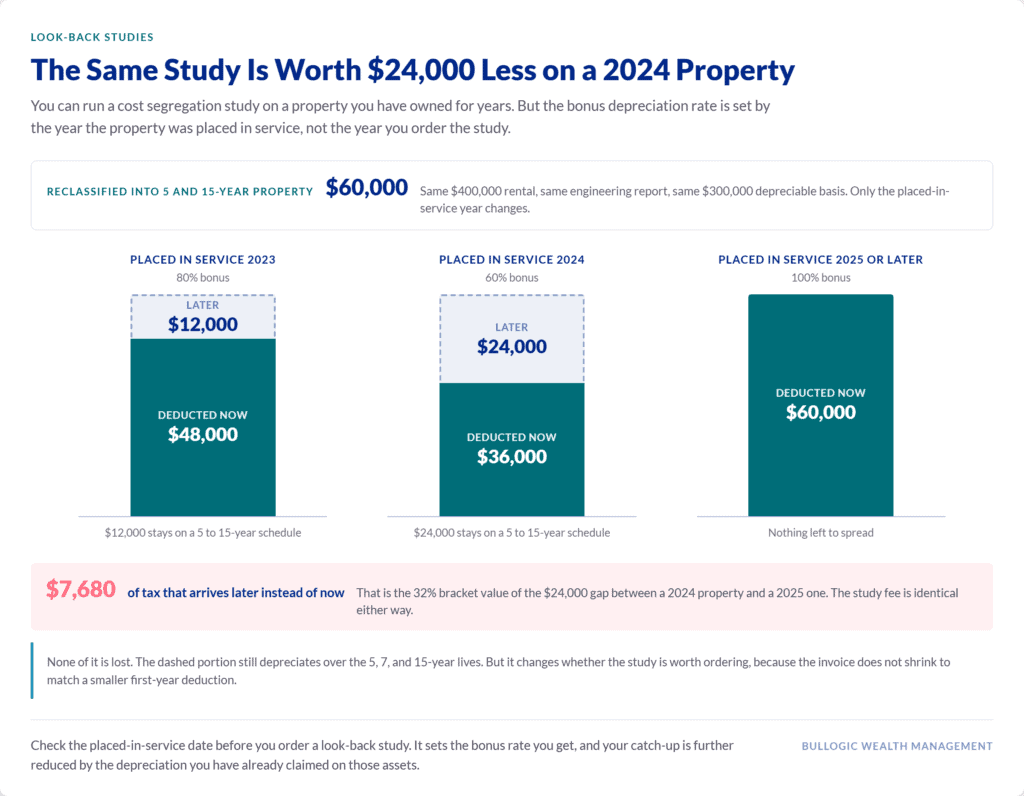
The kicker is that you have to use the tax rules from the year the property was placed in service. If your property went into service in a year when bonus depreciation was only 80% or 60%, that is the percentage you get. This can drastically cut your expected deduction when you were expecting 100%.
Take the $400,000 residential rental from earlier, with $300,000 of depreciable basis and $60,000 reclassified into 5 and 15-year property. Here is what that same study produces depending on when the property was placed in service:
| Placed in service | Bonus rate | Deducted immediately | Left on a 5 to 15-year schedule |
|---|---|---|---|
| 2023 | 80% | $48,000 | $12,000 |
| 2024 | 60% | $36,000 | $24,000 |
| 2025 or later | 100% | $60,000 | $0 |
Same property, same study, same engineering report. The property placed in service in 2024 gets $24,000 less in immediate deduction than the identical property placed in service in 2025. For an owner in the 32% bracket, that is $7,680 of tax that arrives later instead of now.
None of it is lost. The remainder still depreciates over the 5, 7, and 15-year lives. But it changes the answer to whether the study is worth ordering, because the study fee is the same either way while the year-one benefit is not.
One more thing to expect: your catch-up is reduced by the depreciation you have already claimed on those assets under the old single-line schedule. The longer the property has been in service, the more of the benefit you have already taken and the smaller the §481(a) adjustment gets.
Not all cost segregation studies are the same
What makes a cost segregation study audit-defensible?
An engineered study, where someone inspects the property and documents each component against actual cost records, is the standard the IRS treats as most reliable. Questionnaire and software-only studies cost less but arrive with disclaimers. The gap is usually a few thousand dollars on a deduction you may have to defend for years.
The price gap between a $1,000 study and a $5,000 study looks like a choice. It is not really.
The IRS publishes a Cost Segregation Audit Techniques Guide. It exists because these studies get examined, and it tells examiners what a credible one looks like. The guide ranks methodologies by reliability. The approach it treats as most reliable is a detailed engineering analysis built from actual cost records and a physical inspection of the property. The approaches it treats as least reliable are the ones built from rules of thumb and estimates.
That ranking is the whole story on price.
An engineered study means someone goes to the property. They photograph and measure. They pull construction records, invoices, and blueprints where those exist. They assign every component a class and a cost, and the total reconciles back to what you actually paid for the building. You end up with a report that shows its work.
A questionnaire study means you filled out a form and uploaded some photos. Software applied percentages. Nobody visited. The report arrives with disclaimers, because the firm knows exactly what it is and is not.
Both produce a number. Only one produces a number you can defend.
Here is the part that matters. You are not buying a report. You are buying a six-figure deduction that sits on your depreciation schedule for decades and gets recaptured when you sell. If that number does not hold up, you are not just losing the deduction. You are looking at back tax, interest, and potentially penalties, on a return you filed years ago.
Questions worth asking before you hire anyone:
- Does someone physically inspect the property, or is this done remotely?
- Who performs the analysis, and what is their engineering background?
- Does the study reconcile to my total purchase price and capitalized costs?
- Does the report state the methodology it used?
- Do you provide audit support if the study is examined, and is that included or extra?
- Have you defended a study through an actual examination?
That last one is the most useful question on the list and the one people forget to ask.
When to talk to a wealth-and-tax advisor
When should a property owner talk to a wealth-and-tax advisor about cost segregation?
Before you order the study, not after. Whether a study pays off depends on your bracket, whether you can use the loss, how long you plan to hold, and what your exit looks like. Those are all planning questions, and they all have answers before you spend anything.
Cost segregation is a planning decision more than a tax filing decision, and the planning happens before you spend money on a study.
It is worth a conversation if:
- You are under contract on a property and want to model the deduction before you close, while you can still walk.
- You own a property placed in service in a prior year and have never run a study. The look-back is available, and so is the bonus percentage from that year.
- You have a quote in hand and want the numbers checked before you commit to it.
- You are considering a short-term rental specifically to unlock the loss, and want to know whether you can realistically hit material participation.
- Your income spiked this year from a bonus, an RSU vest, or a business sale, and you are looking for something that can absorb it.
- You are approaching a sale and want to know the recapture number before you are sitting at the closing table.
We do not sell cost segregation studies. We help you work out whether one makes sense for your situation, what it should produce, and what to look for in a provider.
And because the tax planning and the wealth planning happen in the same place, the deduction gets evaluated against everything else going on in your year rather than on its own.
Schedule a 30-minute strategy call with Bullogic Wealth Management
Summary
Cost segregation is not free money. It is a timing tool. You are moving deductions from later to now, and the tax code allows it because the components inside a building genuinely wear out faster than the building itself does.
That timing shift is worth real money when the conditions are right. The client study at the top of this post turned $10,710 of annual depreciation into $147,168 in a single year, and in the 35% bracket that is more than $51,000 of tax deferred. Those figures came off an actual report, not a projection.
But the conditions have to be right, and there are three of them. You need enough depreciable basis once the land comes out, which is where a lot of properties fail before anything else gets considered. You need a bracket high enough that a deduction is worth taking, which for most people means above 24%. And you need a way to move the loss from passive to nonpassive in the same year you take it, because a suspended loss does nothing for you.
You also need to understand the back end before you commit. The components a study carves out come back at your ordinary rate rather than the 25% cap that applies to the building. Cost segregation does not only accelerate the deduction. It changes what it costs you to pay it back.
None of that makes it a bad strategy. It makes it a decision. And every part of that decision is answerable before you spend a dollar on a study, which is exactly when it should be answered.
The deduction is accelerated, not created, so it returns as recapture at sale. Reclassified components recapture under §1245 at ordinary rates rather than the 25% cap on the building. A study can also generate a loss you cannot use, and some states do not conform to federal bonus depreciation.
On a $527,725 short-term rental with $417,725 of depreciable basis, a study split the property into 39, 15, and 5-year classes. With bonus depreciation the first-year deduction was $147,168 instead of $10,710. In the 35% bracket, that is $51,508 of tax deferred.
Any owner of income-producing real property, including residential rentals, short-term rentals, and commercial buildings. Your primary residence does not qualify because it produces no income, and land never qualifies because land is not depreciable.
The 2% rule is a cash flow screen suggesting monthly rent should be at least 2% of the purchase price. It has nothing to do with cost segregation, which is a depreciation strategy. The two get searched together but they answer completely different questions.
Engineered studies typically run $3,000 to $15,000 depending on property size and complexity. Questionnaire-based studies cost less but carry weaker audit support. The study only makes sense if the usable deduction it produces, valued at your marginal rate, clears the fee with room to spare.