
Self-Rental: Should You Own the Building Your Business Is In?
Self-rental is when you own a building and rent it to a business you run. The tax code treats it asymmetrically: net rental income is recharacterized as non-passive, so it cannot be offset by passive losses, while net rental losses stay passive and get trapped. A grouping election can fix that asymmetry, but it is generally irreversible and it changes what happens when you sell. The deduction is not the real reason to do this. The real reason is that you can sell the business one day and keep the building.
The Augusta Rule: How to Rent Your Home to Your Business (and What It Actually Saves)
The Augusta Rule (IRC §280A(g)) lets you rent your home for up to 14 days a year and pay zero tax on the rental income. Business owners use it by having their company rent the home for legitimate meetings: the business deducts the rent, and you receive it tax-free. It is real and it is legal, but the honest savings are usually a couple thousand dollars a year, not the $30,000 the hype promises. It only works if your business is a separate entity (S-corp, C-corp, or partnership), the rate is defensible, and the meetings are genuine.
ROBS: How to Fund a Business With Your Retirement Money (and When You Shouldn’t)
A ROBS lets you use 401(k) or IRA money to fund a business without the 10% early-withdrawal penalty or income tax. It works by forming a C corporation whose retirement plan buys the company’s stock. It is legal but heavily audited, and a single compliance failure can disqualify the plan and make your entire rolled-over balance taxable in one year.
How a Cash Balance Plan Works (and Who Should Actually Use One)

A cash balance plan is a type of defined benefit pension plan built to look and feel like a 401(k), with a hypothetical account balance that grows from an annual pay credit and a fixed interest credit. The draw is the contribution ceiling. Because the limit is age-based, an older high earner can shelter well over $200,000 a year, far beyond a 401(k), and stacking the two pushes the total higher still. The trade-off is a multi-year funding commitment, an annual actuary, and a required contribution for any employees. It is the biggest legal tax deferral most profitable owners have never used, and it is not for everyone.
Retirement Plans for Small Business Owners: How to Choose the Right One
Small business owners have five main retirement plans to choose from: the Solo 401(k), SEP IRA, SIMPLE IRA, traditional or Roth IRA, and Defined Benefit or Cash Balance plans. The right one depends on your income, your business entity, the salary you pay yourself, and whether you have employees. Solopreneurs and high earners usually get the most from a Solo 401(k). Owners with rising income who want to shelter the largest amounts look at adding a Cash Balance plan. The plan you choose sets a ceiling, but how much of that ceiling you can actually reach is a function of how your business and your pay are structured.
Fringe Benefits for S-Corp and C-Corp Owners: The Tax Planning Guide
A fringe benefit is any form of non-wage compensation an employer provides to an employee. The IRS treats most fringe benefits as taxable wages unless a specific statute makes them tax-free. For C-corp employee-owners, the benefit menu is generous: health insurance, group-term life, education, dependent care, transportation, and HRAs flow through tax-free. For S-corp owners with more than 2% ownership, most of those benefits get added back to W-2 wages and the cafeteria plan is off limits. The entity choice quietly drives the planning math for every fringe benefit you provide yourself.
The Accountable Plan: The Simple S-Corp Strategy Most Business Owners Are Missing

An accountable plan is an IRS-approved reimbursement policy that lets an S-corp pay its owner-employees back for legitimate business expenses (home office, cell phone, mileage, internet, etc.) tax-free to the owner and fully deductible to the business. Without one, those out-of-pocket expenses became non-deductible after the Tax Cuts and Jobs Act suspended misc itemized deductions. The plan is one of the simplest tax structures to set up: a written policy, monthly expense reports, and a return-of-excess rule. Most S-corp owners never set one up because it’s a documentation system, not a return line item, and most tax preparers don’t proactively recommend it.
How an Active Trader Cut His Tax Bill by $142,674 and Funded $117,250 in Annual Retirement Contributions
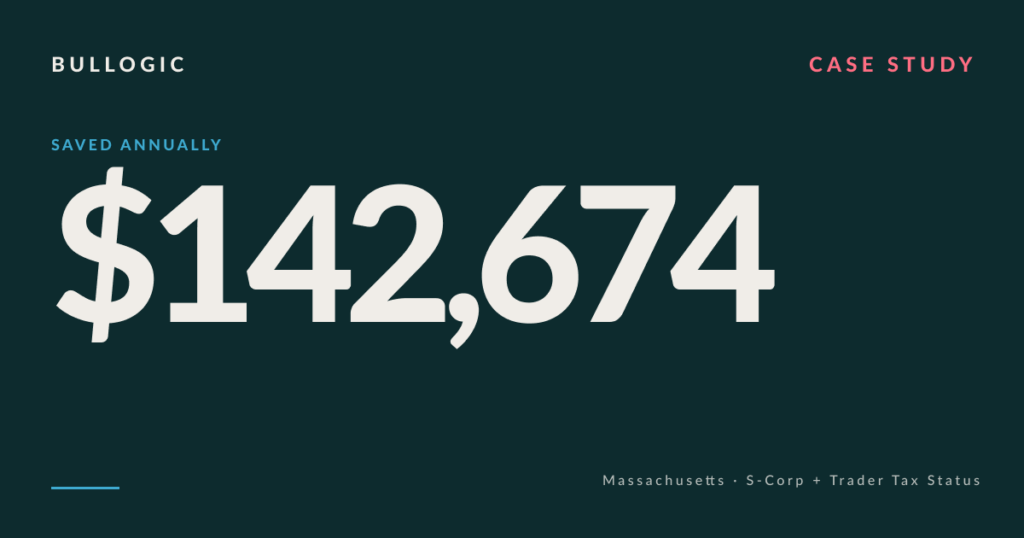
An active trader walked in paying $634,114 in annual tax with zero retirement savings. Four coordinated moves cut his tax bill to $491,440 (saving $142,674 per year) and built $117,250 of annual retirement contributions where there had been none. The moves: Trader Tax Status election with §475(f) mark-to-market, an S-corp structure with salary optimization, formalized spousal employment for retirement contribution stacking, and a Massachusetts PTET election. This is the long-form companion to our published case study.
Tax Benefits of Hiring Family Members: When the Strategy Works (and When It Doesn’t)
Hiring family members in your business is one of the cleanest tax strategies the IRC allows. Pay your child up to the standard deduction (16,100 for 2026) and they owe no federal income tax. Pay your spouse and you open Solo 401(k) and benefit contribution room. The strategy works for every entity type, but the mechanics shift, FICA is exempt for kids under 18 only when the business is a sole prop or partnership of both parents. The catch isn’t the strategy. It’s the documentation.
C-Corporation Tax Benefits: When the 21% Flat Rate Actually Saves You Money
A C-corporation pays a flat 21% federal tax on profits, regardless of income level. For some owners, that beats the individual brackets they’d pay through an S-corp or LLC, especially when retaining earnings for reinvestment, planning a future sale (QSBS §1202 exclusion up to $15M), or running an SSTB above the QBI phaseout. The right strategy is often layering a C-corp onto an existing S-corp, not replacing it.